Posted on

How to cover a boat for winter

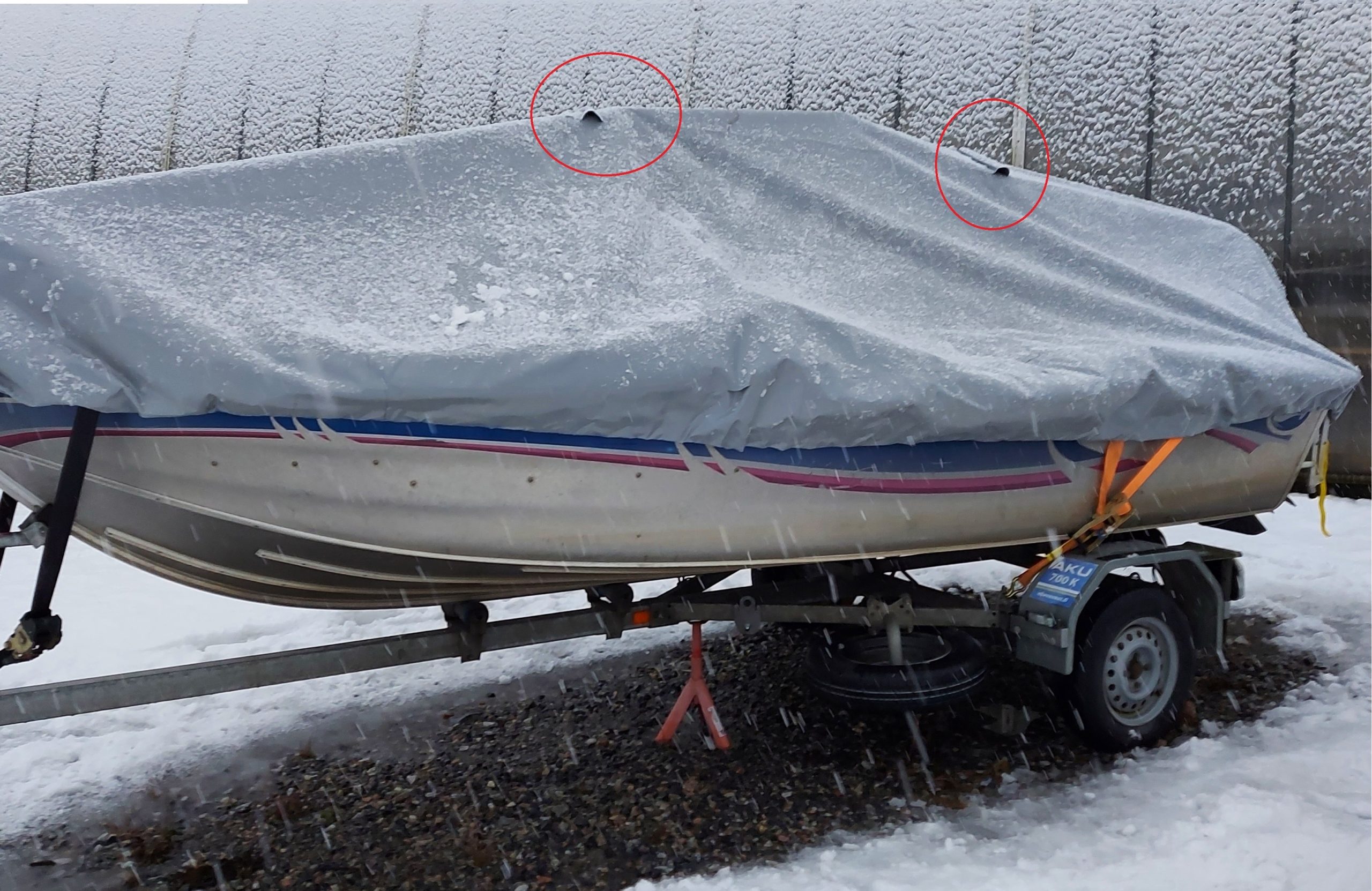
Boat under a PVC cover in falling snow, with both ventilation openings marked

A boat that winters outdoors faces three things a cover has to handle: the weight of wet snow, wind that works at every loose corner, and condensation that turns into mould if the air under the cover cannot move. A good cover fitted badly fails at all three. This guide goes through the job in the order you do it, from preparing the boat in autumn to taking the cover off in spring.

1. Prepare the boat before it goes under the cover

Whatever goes under the cover stays there for five or six months, so start with a boat that is clean and dry.

  • Wash and dry the hull and the deck. Dirt holds moisture against the surface all winter.
  • Take out what can be damaged by damp or theft: cushions, life jackets, electronics, fuel cans and the battery. Store the battery indoors and keep it charged.
  • Drain all water. Bilge, live wells and any hoses. Water left in the boat freezes, expands and cracks fittings.
  • Winterise the engine according to its manual before you cover the boat, so you do not have to open the cover again.
  • Pad sharp edges. Windscreen corners, rod holders and cleats rub through any fabric over a winter of wind. A piece of foam or an old towel taped over them is enough.

2. Give the cover a ridge

The most common reason a winter cover fails is that it lies flat. Snow settles in the flat parts, melts in the day, freezes at night and keeps adding weight until the fabric stretches into a pool – and a pool of water is what tears a cover or fills the boat.

The fix is a crown: something under the cover that holds it up along the centre line so snow and rain run off to the sides. On an open boat, support arches across the hull do this. Ours come in three widths – 90, 120 and 140 cm – placed at the bow, the middle and the stern.
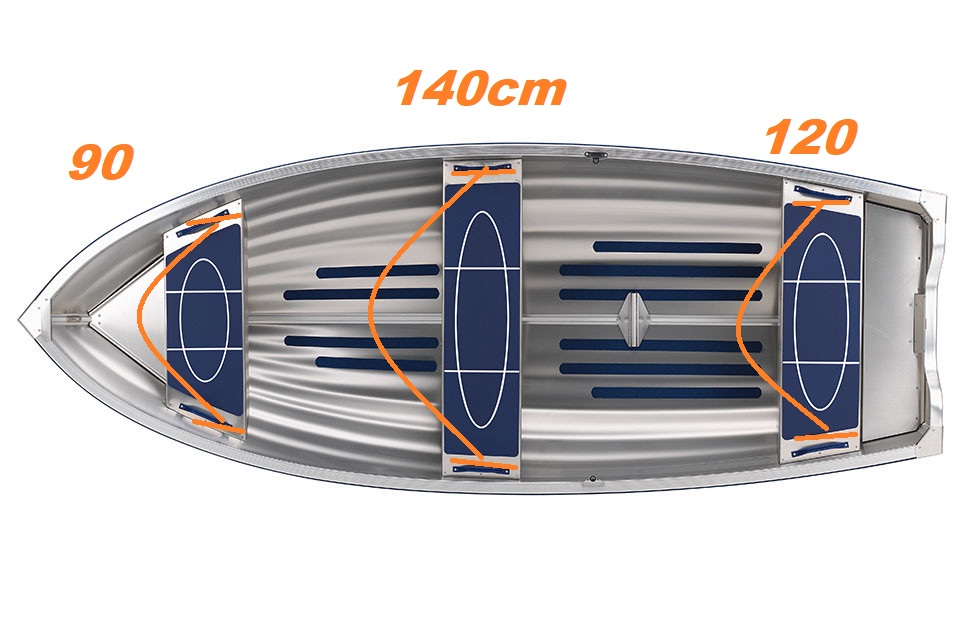
Three support arches placed across an open aluminium boat at the bow, middle and stern
Arches at the bow, middle and stern give the cover a crown along its whole length.

A boat with a console or a windscreen already has a high point; on those the arches go between the high point and the ends so the fabric does not sag between them.

3. Fit the cover and leave the vents free

Pull the cover over from the bow first, then work it down over the gunwale on both sides before tightening anything. A cover cut for the model sits down on the gunwale by itself; a loose one needs to be pulled straight so no fold is left to catch water.

A waterproof cover does not breathe, so the air underneath has to move through openings. Ours have two mesh ventilation openings welded in. Do not block them with the arches, a tarp on top or snow piled against them. The circled openings in the photo below are doing their job in the middle of a snowfall.
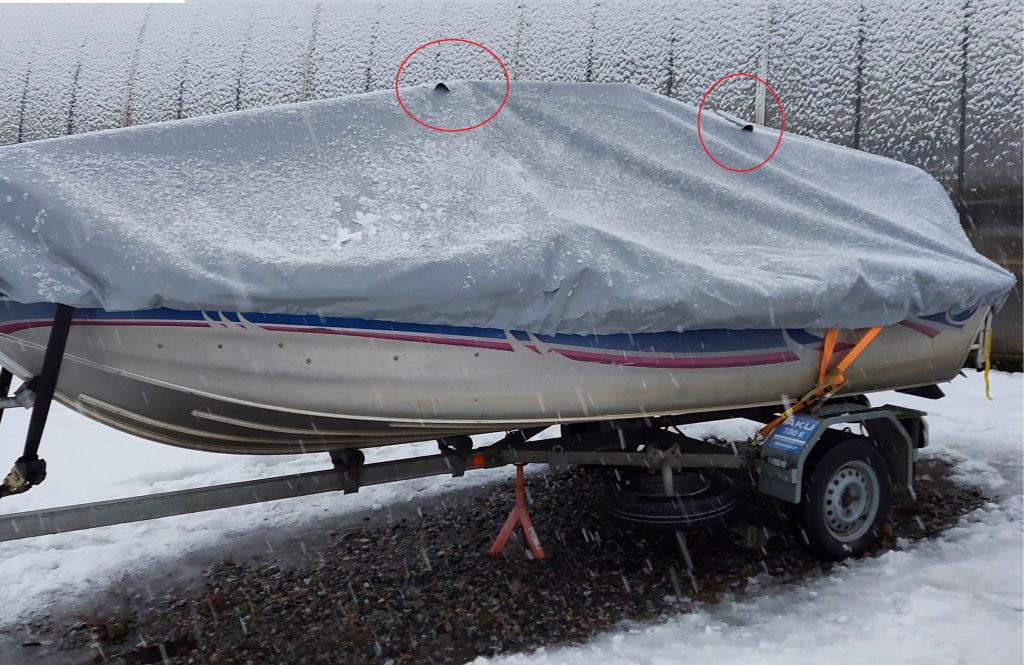
Boat on a trailer under a grey PVC cover in falling snow, with the two ventilation openings circled
The two ventilation openings stay clear of snow because they sit on the high part of the cover.

4. Tension it – against the boat, not against the ground

Tension is what keeps the wind from getting a grip. Pull the cover tight with the ratchet strap at the stern, then tie down along the sides through the eyelets.
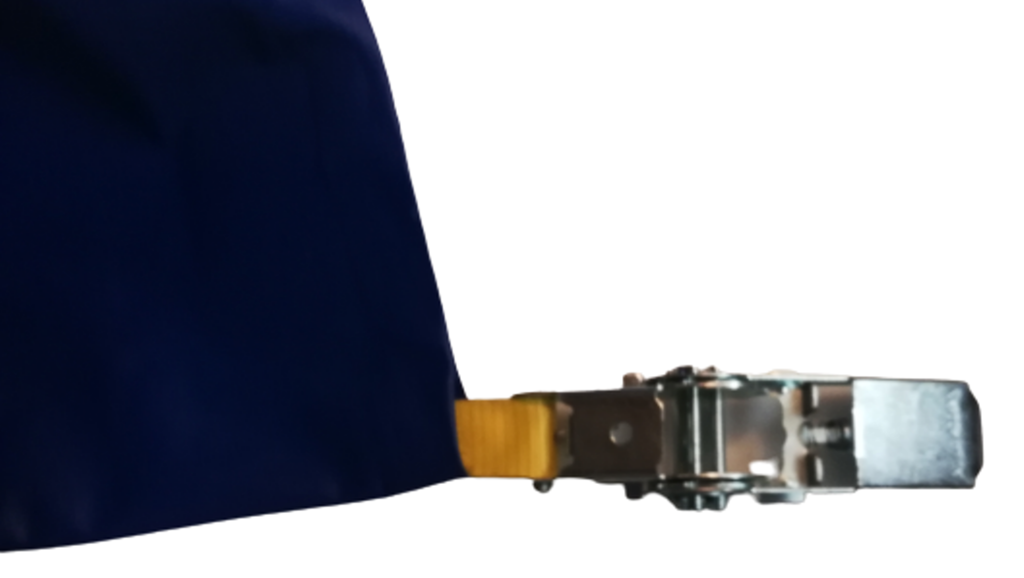
Ratchet tensioner on a webbing strap at the edge of a PVC boat cover
A ratchet holds the tension through wind and the weight of wet snow.
  • Tie the cover to the boat or its trailer, never to loose stands, blocks or anything on the ground. In a storm a cover tied to the ground can pull a boat off its supports.
  • Tight, not drum-tight. The fabric should not flap, but it should still give a little when you press it. PVC shrinks slightly in the cold, so a cover tightened to the limit on a mild day is over-tight in January.
  • Keep straps off sharp edges or pad them where they cross the gunwale.

5. Check it through the winter

A cover that was right in October is not guaranteed to be right in February. Walk past the boat after storms and after heavy snowfall.

  • Brush off heavy, wet snow before it builds up – use a soft brush, never a shovel.
  • Re-tension the ratchet if the cover has started to flap.
  • Make sure the ventilation openings are not buried.
  • Look for places where the fabric rubs on something hard and add padding.

6. Taking the cover off in spring

Wait for a dry day. Brush off dirt and leaves, rinse the cover with water and a mild detergent if it needs it, and let both sides dry completely before you fold it. A cover packed away damp will be mouldy by autumn. Store it folded loosely in a dry place, away from mice.

Why a cover cut for your model

A cover cut for one boat model follows that hull’s own gunwale, console and windscreen, so it sits down without folds and needs less tension to stay put – and a cover without folds leaves water nowhere to collect. Find yours in our list of makes and models. If your boat is not there, we make covers to order – our guide on how to measure your boat for a cover shows what to send us.

Checklist

  • Boat clean, dry and drained; battery and loose gear out.
  • Engine winterised.
  • Sharp edges padded.
  • Arches or a ridge in place – no flat areas.
  • Cover pulled straight, vents clear.
  • Ratchet tight, tie-downs to the boat or trailer.
  • Checked after storms and heavy snow.

Want to know what the cover itself should be made of? We compare the three common materials in PVC vs polyester vs polyethylene boat covers.
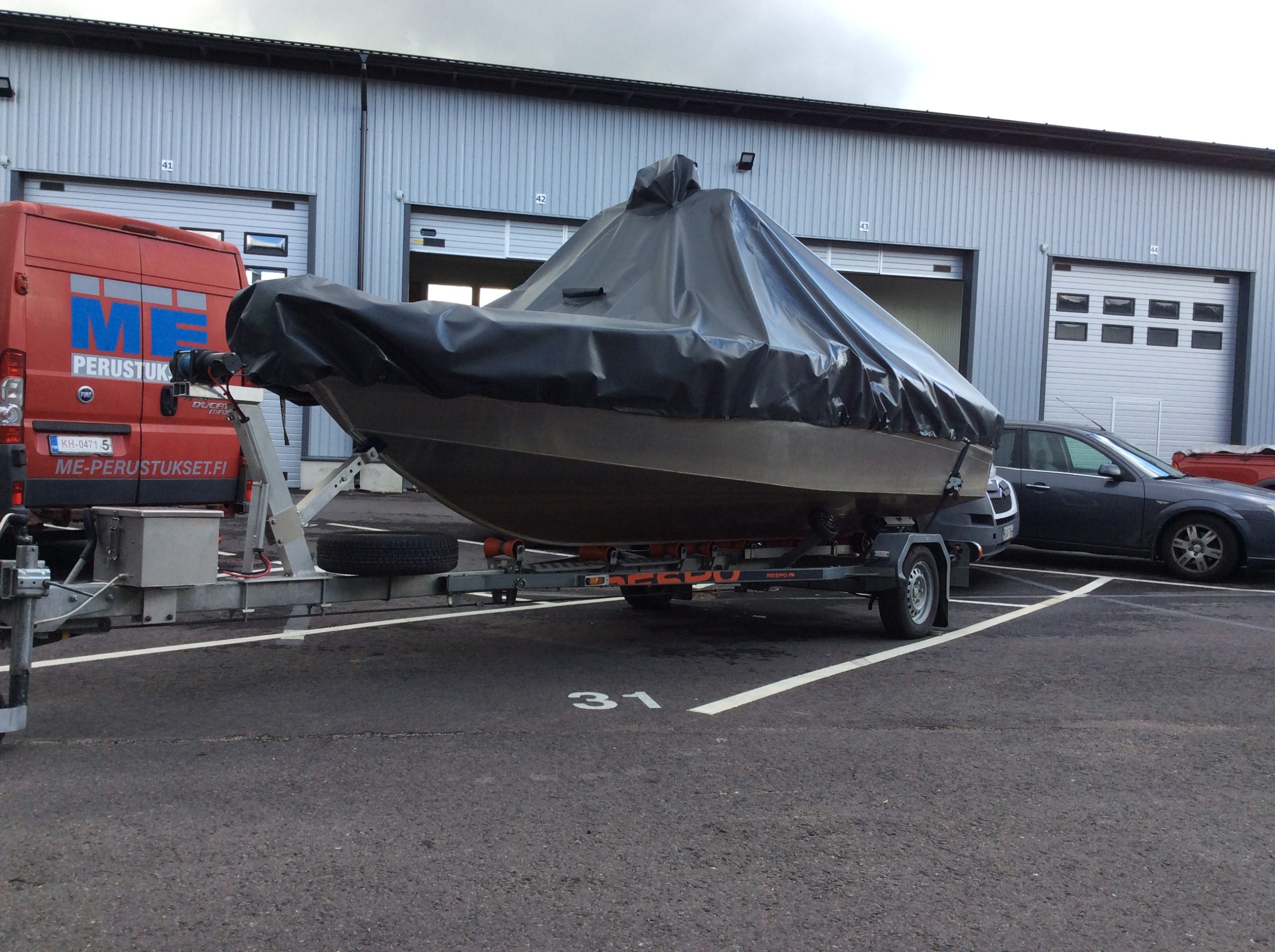
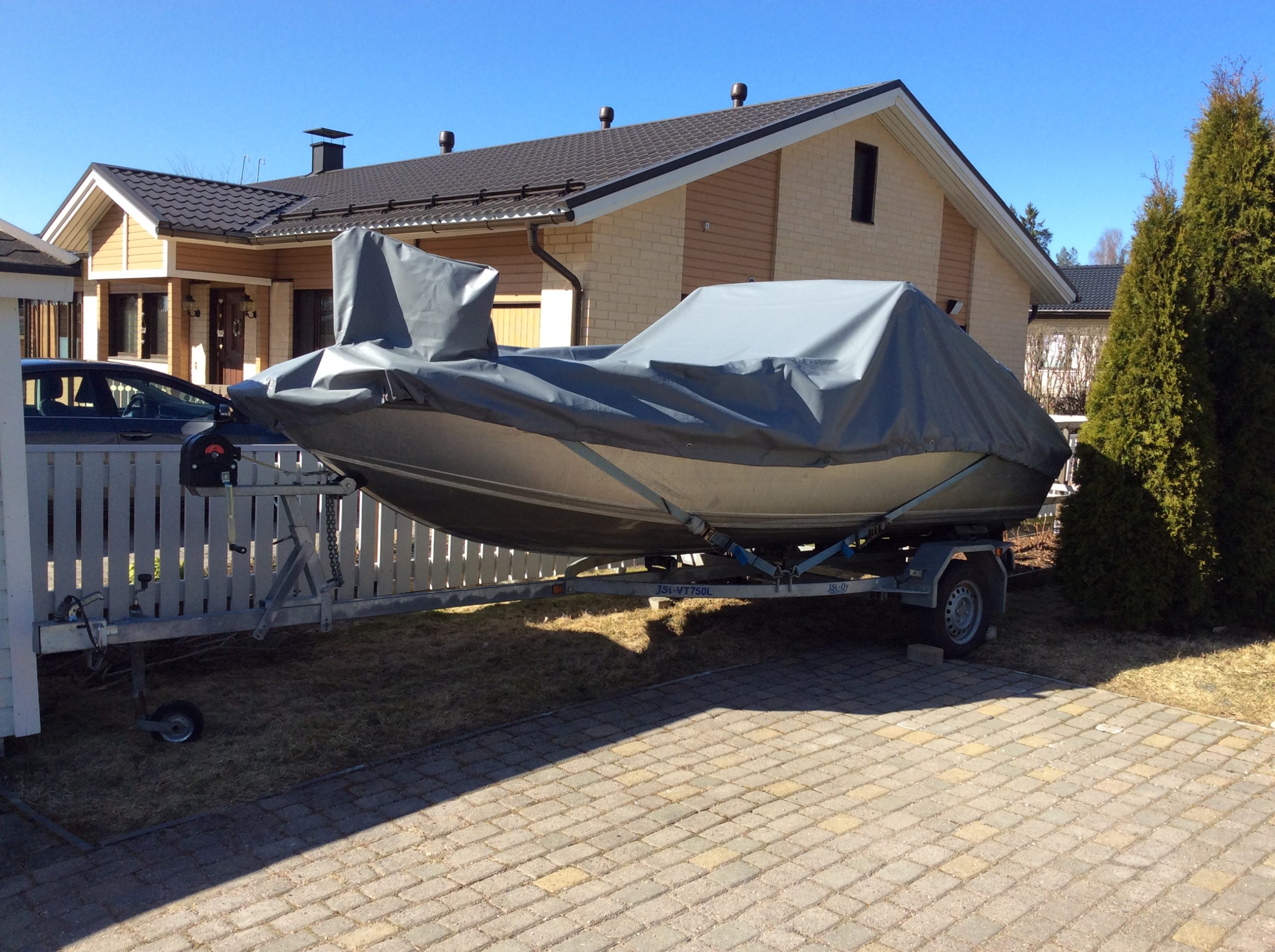
Posted on

How to measure your boat for a cover

Faster 525 CC with its PVC boat cover fitted

A boat cover is bought on measurements. Get them right and the cover sits down on the gunwale without folds; get them wrong and it either does not reach or hangs loose enough for the wind to work at it. This guide shows what to measure, where to put the tape and what to send us if your boat is not in our list.

First: do you need to measure at all?

If your boat is in our list of makes and models, you do not. A model-specific cover is cut from that boat’s own pattern, so the make and model are the measurement. Two things are still worth checking:

  • The generation. Some models changed shape between years. The 2008 Buster XSr and the later XSR, for example, do not share a pattern.
  • The version. A centre-console, a side-console and an open version of the same hull need different covers – the Faster 525 CC and 525 SC are an example.

Measure if your boat is not on the list, or if you are not sure which generation or version you have. With the numbers and two photos we can tell you whether one of our covers fits it – and if none does, we make one to order.

What you need

  • A tape measure of at least 5 m – a soft tailor’s tape helps for the over-the-top measurement.
  • A helper to hold the other end.
  • Your phone, for photos of the boat from the side and from above.

The five measurements

1. Length. Along the centre line, from the tip of the bow to the transom, measured over the deck. Do not include the outboard, the bow eye or a bathing ladder – note those separately if they stick out.

2. Beam. Across the boat at its widest point, from the outside edge of one gunwale to the outside edge of the other. On most boats this is just behind the middle.

3. Height of anything that stands up. Windscreen, console, seat backs, a casting platform – measure each from the gunwale up to its highest point, and note how far it is from the bow.

4. Over the top. Run the tape from the gunwale on one side, up and over the highest point (usually the windscreen or console) and down to the gunwale on the other side, following the surface. This is the measurement that shows how much fabric the cover needs where the boat is tallest – and the one most often forgotten.

5. Shape seen from above. Is the bow pointed or blunt, and is the transom straight or angled? A photo taken from above shows the outline better than any number.

Measurement Where Why it matters
Length Bow tip to transom, centre line, over the deck Decides the size of the cover
Beam Widest point, outside gunwale to outside gunwale Decides whether the cover reaches down on both sides
Heights Windscreen, console, seats – from the gunwale Tall parts take up fabric
Over the top Gunwale – highest point – gunwale The width the cover must have at its tallest point
Shape Outline from above Shows whether a pattern matches your hull

Common mistakes

  • Using the brochure length. A manufacturer’s “length overall” often includes the motor bracket or bow fittings. Measure the boat yourself.
  • Measuring along the bottom of the hull. The cover sits on the gunwale, so measure along the top.
  • Forgetting the windscreen. A cover that fits the length and the beam can still be too narrow over a windscreen or console.
  • Measuring one side only. Check the beam at more than one point, and measure the over-the-top dimension at the tallest part.

Boat not in the list? We make covers to order

Email the make, model and year of your boat, your five measurements and two photos – one from the side, one from above – to batskydd@gmail.com, and we will tell you which cover fits – or make one to order for your boat and send you a price. Once it is on the boat, our guide on how to cover a boat for winter covers the rest.

Posted on

PVC vs polyester vs polyethylene boat covers

Buster L2 with its PVC boat cover fitted

Most boat covers are made of one of three materials: PVC-coated fabric, polyester canvas or woven polyethylene. They look similar on a product page and behave very differently after a winter outdoors. This comparison sets out how they differ and where each one makes sense. We make our covers from 600 g/m² PVC, and we explain why below – but each material has a job it does well.

The three materials at a glance

PVC-coated fabric Polyester canvas Polyethylene (PE) tarp
What it is Polyester base fabric coated on both sides with PVC Woven polyester, usually with a water-repellent coating Woven polyethylene strips, laminated
Typical weight 500–900 g/m² 200–350 g/m² 80–250 g/m²
Waterproof Fully Water-repellent; needs re-proofing over time When new; less as UV breaks it down
Breathes No – needs ventilation openings Partly No
Seams Welded Sewn Hemmed, eyelets in the hem
Snow load and wind Strong; heavy enough not to flap Good if well tensioned Light; flaps and tears at the eyelets
UV Good with UV-stabilised coating Varies with fabric and coating Weakest unless UV-stabilised
Price Mid Mid to high Low
Best for Winter storage outdoors Mooring and summer covers Short-term or temporary cover

Weights and behaviour are typical ranges for each material; individual products vary.

PVC-coated fabric

PVC covers are a polyester base fabric sealed on both sides with a PVC coating. Because the coating is continuous and the seams can be welded rather than stitched, nothing passes through – not rain, not meltwater. The weight is an advantage outdoors: a 600 g/m² cover lies down on the boat instead of lifting in the wind, and it carries the weight of wet snow without stretching.

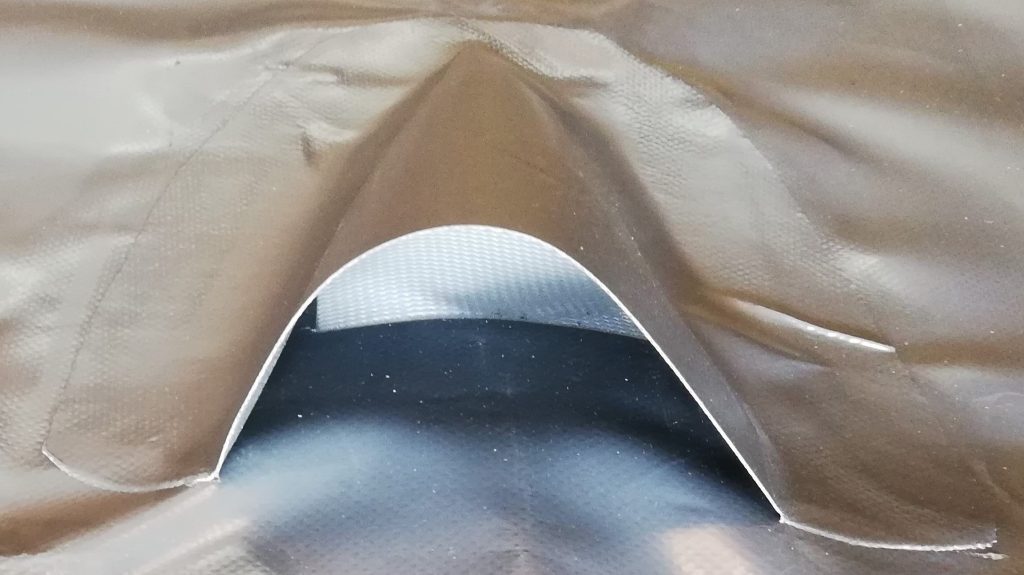
The trade-off is that PVC does not breathe. Moisture from the boat and the ground collects under the cover unless air can move through it, so a PVC cover needs ventilation openings. Ours have two mesh openings welded in; a PVC cover without them will grow mould over a winter.

Arched ventilation opening welded into a grey PVC boat cover
A welded ventilation opening lets air move under a waterproof cover.

Our covers are made from 600 g/m² PVC that stays flexible below freezing and carries UV protection for the summer half of the year. With normal use we expect around five years of service.

Polyester canvas

Polyester canvas is lighter, softer and partly breathable, which is why it is the usual choice for covers that stay on a boat in the water through the summer or on a boat that is used every weekend. It folds small and looks tidy.

Its coating is water-repellent rather than waterproof, and the sewn seams are where water gets in first. Over time the coating wears and the fabric needs re-proofing. Under a winter of snow a lighter canvas also needs a good frame underneath, because it stretches where snow collects.

Polyethylene (PE) tarp

The blue or green tarp sold in hardware shops is woven polyethylene. It is cheap, light and waterproof when new, and for a few weeks of cover it does the job. Outdoors over a whole winter it is the weakest of the three: sunlight breaks the material down, it flaps in the wind, and the eyelets tear out of the hem. A tarp tied over a boat also has no shape, so it lies flat and collects snow and water.

Breathability vs ventilation

A material that breathes lets some moisture out through the fabric itself. A waterproof material does not, and has to rely on openings. Neither is automatically better: a breathable canvas still needs air to move under it in a damp autumn, and a waterproof PVC cover with good vents keeps the boat drier than a breathable one that leaks at the seams. What matters is that air can get in and out, and that the cover is shaped so water runs off – see our guide on how to cover a boat for winter.

Fitted vs loose

Material is half the answer; shape is the other half. A cover cut for one boat model sits down on the gunwale without folds and needs less tension to stay put, whichever material it is made of. A loose cover of the best fabric still collects water in its folds. Our boat covers are each cut for one model: find yours in our list of makes and models, and if it is not there, we make one to order – see our guide on how to measure your boat for what to send us.

Which one to choose

  • The boat winters outdoors in the Nordics: PVC. Snow load, wind and five months of weather are what it is built for.
  • The boat stays in the water through the summer and is used often: polyester canvas.
  • You need cover for a few weeks: a polyethylene tarp will do – over a frame, so it does not lie flat.